Modern excavators rely on electronic control systems to manage engine performance, fuel injection, emissions, and communication with other machine systems. At the center of this electronic system is the ECU. An excavator engine ECU continuously receives information from sensors and uses programmed control strategies to determine how the engine should operate.
What Is an Excavator Engine’s ECU?
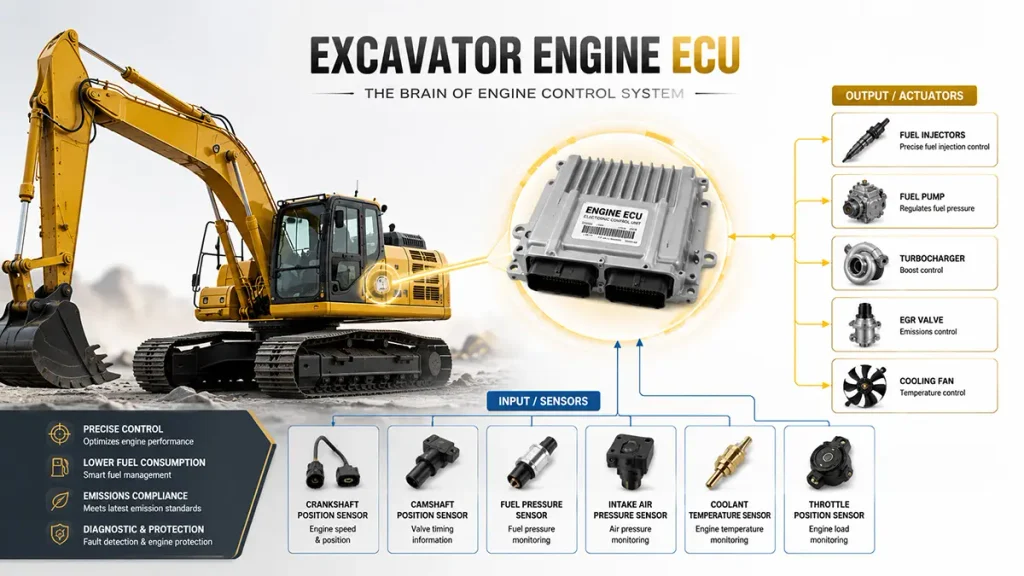
The ECU receives real-time data from multiple sensors, processes this information according to its internal software, and sends control signals to components such as fuel injectors, fuel pumps, turbocharging systems, and other engine actuators.
In simple terms:
Sensors → ECU → Data Processing → Actuators → Engine Operation
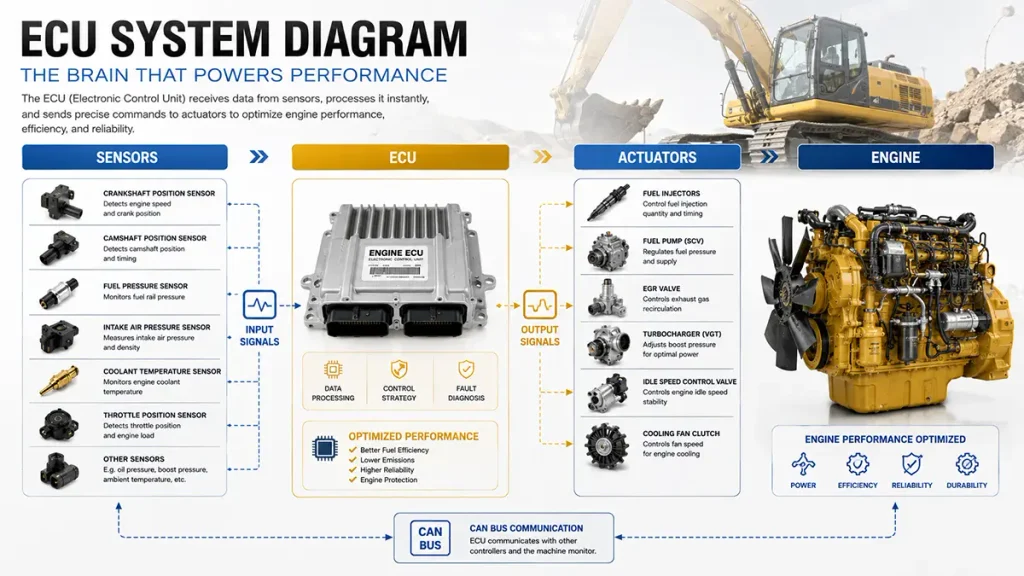
For example, when the operator increases the throttle, the ECU does not simply increase fuel delivery mechanically. It analyzes engine speed, coolant temperature, intake air pressure, fuel pressure, throttle position, and other parameters before determining the appropriate fuel injection quantity and timing.
This allows modern excavator engines to achieve better power output, fuel efficiency, emissions control, reliability, and protection against abnormal operating conditions.
Main Functions of an Excavator Engine ECU
An ECU performs several important functions during excavator operation.
1. Fuel Injection Control
The ECU controls fuel injection timing, duration, and quantity according to engine operating conditions.
2. Engine Speed Control
The ECU monitors engine RPM and adjusts fuel delivery to maintain the required engine speed under different loads.
3. Engine Protection
The ECU can monitor parameters such as coolant temperature, oil pressure, fuel pressure, and intake pressure.
4. Emissions Management
On engines equipped with electronic emissions systems, the ECU works with components such as EGR systems, exhaust aftertreatment systems, and related sensors to help control emissions.
5. Fault Diagnosis
When a sensor, actuator, wiring circuit, or engine parameter operates outside the expected range, the ECU can record a diagnostic fault code.
6. Communication With Other Systems
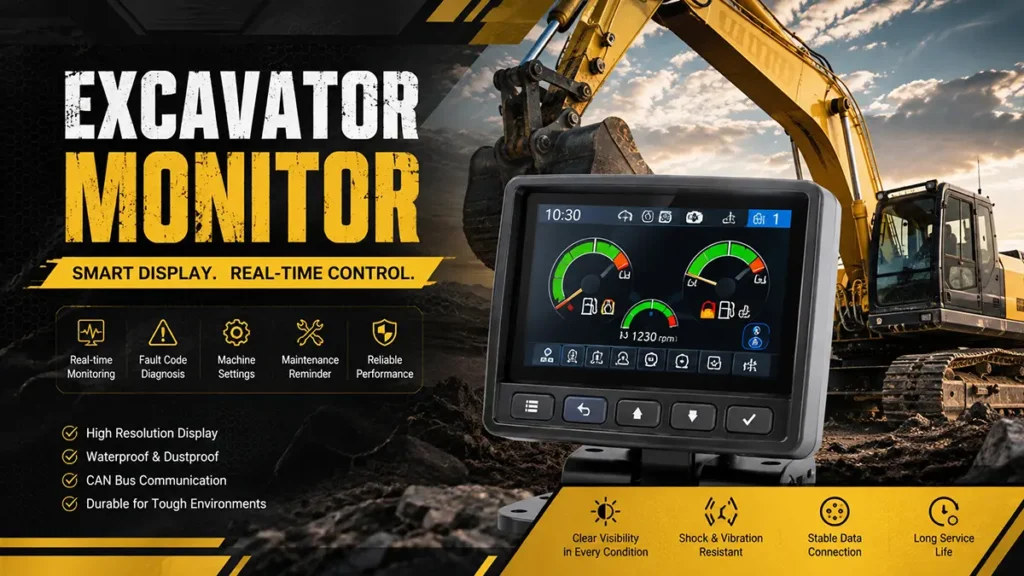
The engine ECU can communicate with the excavator’s main controller, monitor, hydraulic control system, and other electronic modules through communication networks such as CAN bus.
What Is an ECU?
The engine ECU normally consists of three major elements:
- Electronic hardware: Microprocessors, memory, circuits, connectors, and power-management components.
- Software: Control programs and calibration data that determine how the engine responds to different conditions.
- Communication interface: Systems such as CAN communication that allow the ECU to exchange information with other controllers.
The ECU is usually connected to the engine through a wiring harness. Sensors send operating information to the ECU, while the ECU sends commands to actuators.
ECU Programming: Everything You Need to Know
Replacing an excavator ECU may require programming, configuration, parameter setup, or calibration, depending on the engine and controller design.
Why Does an ECU Need Programming?
Different engines and machines may use different software versions, calibration files, operating parameters, and configurations.
ECU programming may be required to:
- Load the correct engine software
- Configure engine parameters
- Match the ECU to the engine
- Configure machine-specific settings
- Calibrate certain sensors or actuators
- Update software
- Clear or manage diagnostic information
- Establish communication with other control modules
The exact procedure depends on the engine manufacturer, ECU model, machine model, and diagnostic system.
What Happens During ECU Programming?
Although the exact procedure differs between manufacturers, ECU programming generally follows this process:
Step 1: Identify the Machine and Engine
First, technicians identify the excavator model, engine model, serial number, ECU part number, and software requirements.
Step 2: Connect Diagnostic Equipment
A compatible diagnostic tool is connected to the machine’s diagnostic connector or directly to the ECU system.
Step 3: Check ECU Information
The technician checks the existing ECU’s software version, calibration information, fault codes, and configuration.
Step 4: Load the Correct Software or Calibration
If required, the appropriate software or calibration file is installed according to the manufacturer’s specifications.
Step 5: Configure and Calibrate
Specific machine or engine parameters may need to be configured. Some systems may also require sensor or actuator calibration.
Step 6: Test Engine Operation
After programming, the engine is started and monitored. Technicians check engine speed, fuel pressure, coolant temperature, communication status, fault codes, and other relevant parameters.
How to Tell if an Excavator ECU May Be Faulty
An ECU should not be replaced simply because an engine has a fault code. Many engine problems are caused by sensors, wiring, power supply, fuel systems, or communication faults rather than the ECU itself.
However, several symptoms may indicate a possible ECU-related problem:
- Engine does not start
- Engine suddenly shuts down
- Abnormal or unstable engine speed
- Multiple unrelated sensor faults appear simultaneously
- Communication failure between ECU and monitor
- Diagnostic equipment cannot communicate with the ECU
- ECU power supply or internal circuit faults
- Repeated fault codes remain after external components have been checked
- Engine enters a protection or limp mode
Before replacing an ECU, technicians should inspect the battery voltage, grounds, fuses, relays, wiring harnesses, connectors, CAN communication, sensors, and actuators.
Buying Guide: How to Choose the Right ECU for Your Machinery
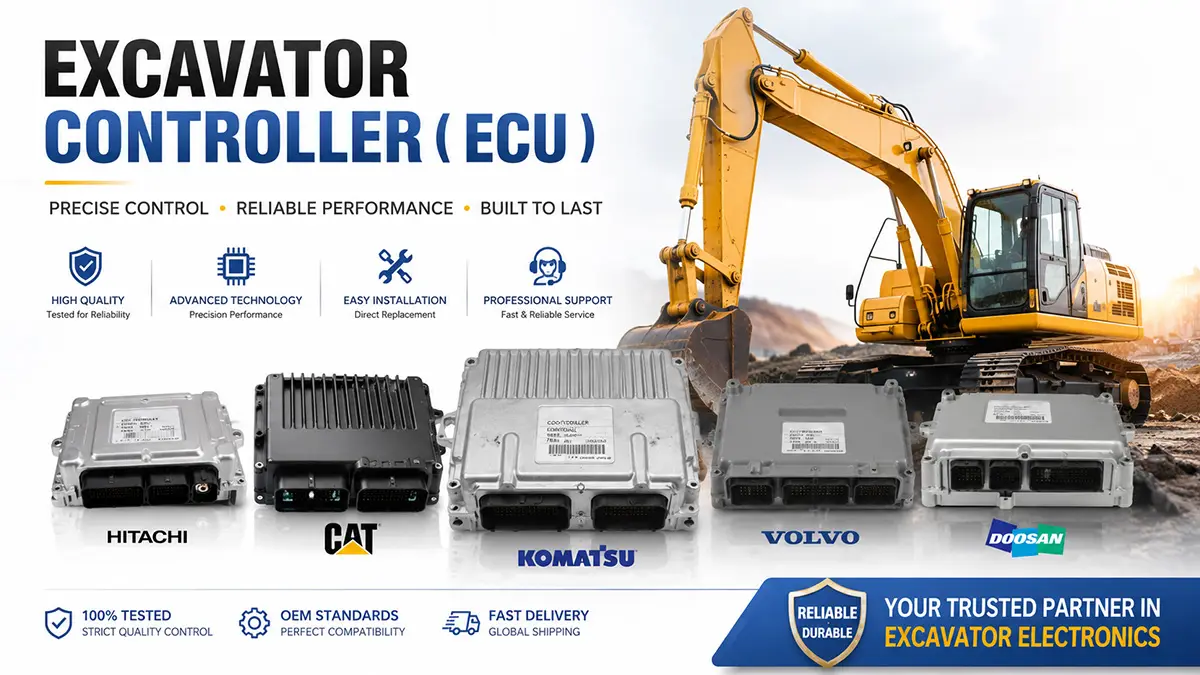
Choosing the correct excavator ECU is critical. An ECU that looks identical may still have different software, calibration, communication settings, or hardware specifications.
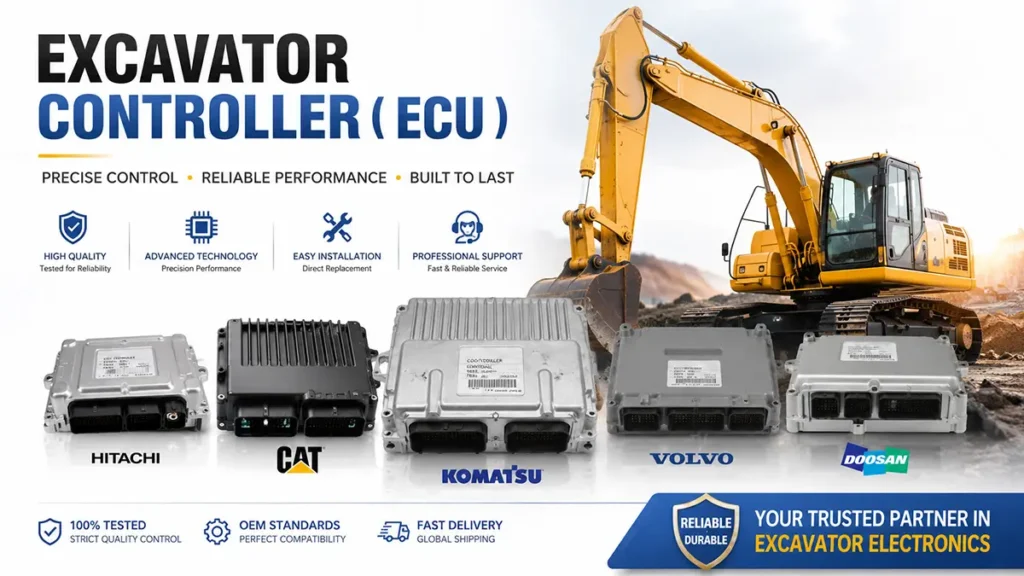
The safest approach is to identify the ECU using both the part number and the machine nameplate.
1. Check the ECU Part Number
The ECU’s part number is one of the most important identification references.
Look for information printed on the ECU label, such as:
- Part Number
- Model Number
- Serial Number
- Hardware Number
- Software or Calibration Information
- Manufacturer Information
When purchasing, provide the complete and exact part number whenever possible.
2. Check the Machine Nameplate
The machine nameplate provides important information for confirming compatibility.
Depending on the excavator, the nameplate may include:
- Machine model
- Serial number
- Manufacturing year
- Engine model
- Rated power
- Product identification number
3. Confirm the Engine Model
The engine model is another important compatibility reference.
Always confirm:
Excavator Model → Engine Model → ECU Part Number
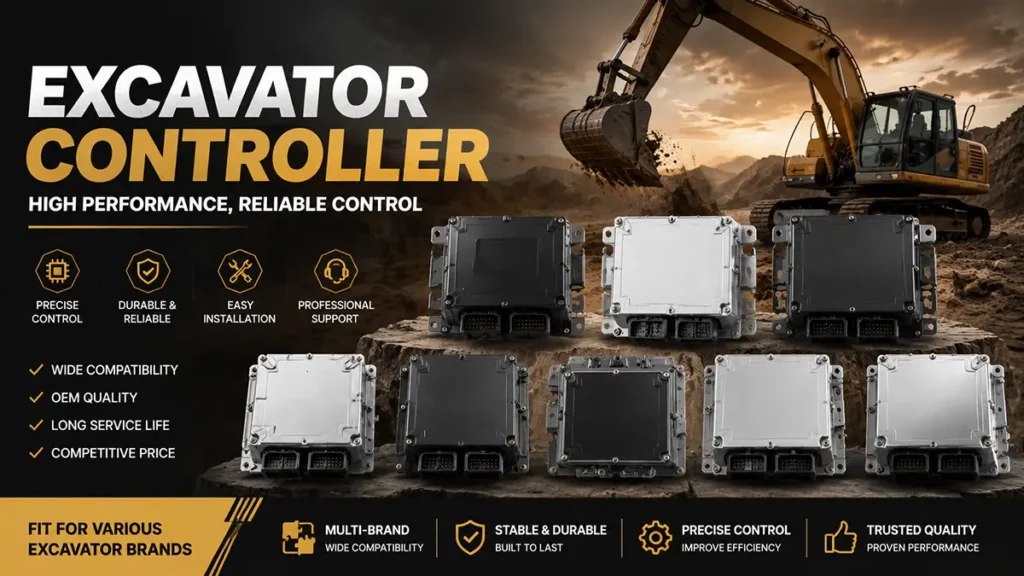
4. Compare the ECU Connector and Hardware
Before purchasing, compare the replacement ECU with the original unit.
Check:
- Connector type
- Number of connectors
- Connector position
- Mounting holes
- Housing dimensions
- Label information
- Hardware version
A physically similar ECU is not necessarily electronically compatible.
Conclusion
The excavator engine ECU is one of the most important electronic components in a modern excavator. It processes information from sensors and controls critical engine functions such as fuel injection, engine speed, protection strategies, emissions management, diagnostics, and communication with other machine systems.
When an ECU needs to be replaced, selecting the correct part is essential. Do not rely solely on appearance or excavator model. Instead, verify the ECU part number, machine nameplate, engine model, machine serial number, connector configuration, and programming requirements.
If you have any technical questions or would like to learn more about our products, please feel free to contact us.
FAQs
1. What does an ECU do on an excavator?
An excavator engine ECU monitors engine sensors and controls functions such as fuel injection, engine speed, engine protection, emissions systems, diagnostics, and communication with other electronic controllers.
2. Can an excavator ECU be repaired?
Some ECUs can be repaired or remanufactured if the problem is caused by repairable electronic components. However, severe circuit-board damage, software problems, or internal processor failures may require replacement.
3. How do I find the correct ECU for my excavator?
Start with the ECU part number. Then verify it against the excavator model, machine serial number, engine model, and machine nameplate. Do not select an ECU based only on its appearance.
4. What information should I provide when buying an excavator ECU?
Provide the ECU part number, excavator model, machine serial number, engine model, and photos of the ECU label and machine nameplate.
5. What is the difference between an ECU and an ECM?
The terms are often used interchangeably, although naming conventions vary by manufacturer. Both generally refer to an electronic controller responsible for monitoring and controlling engine functions.
6. Can a faulty sensor damage the ECU?
A sensor fault does not necessarily mean the ECU is damaged. However, short circuits, incorrect wiring, voltage problems, or severe electrical faults can potentially damage electronic control components. Proper diagnosis should be performed before replacing the ECU.
7. Why won’t my excavator start after replacing the ECU?
Possible causes include incorrect ECU compatibility, missing programming or calibration, immobilizer or security configuration, communication problems, wiring faults, insufficient power supply, or unrelated engine problems. The ECU should be diagnosed using compatible service equipment before assuming it is defective.