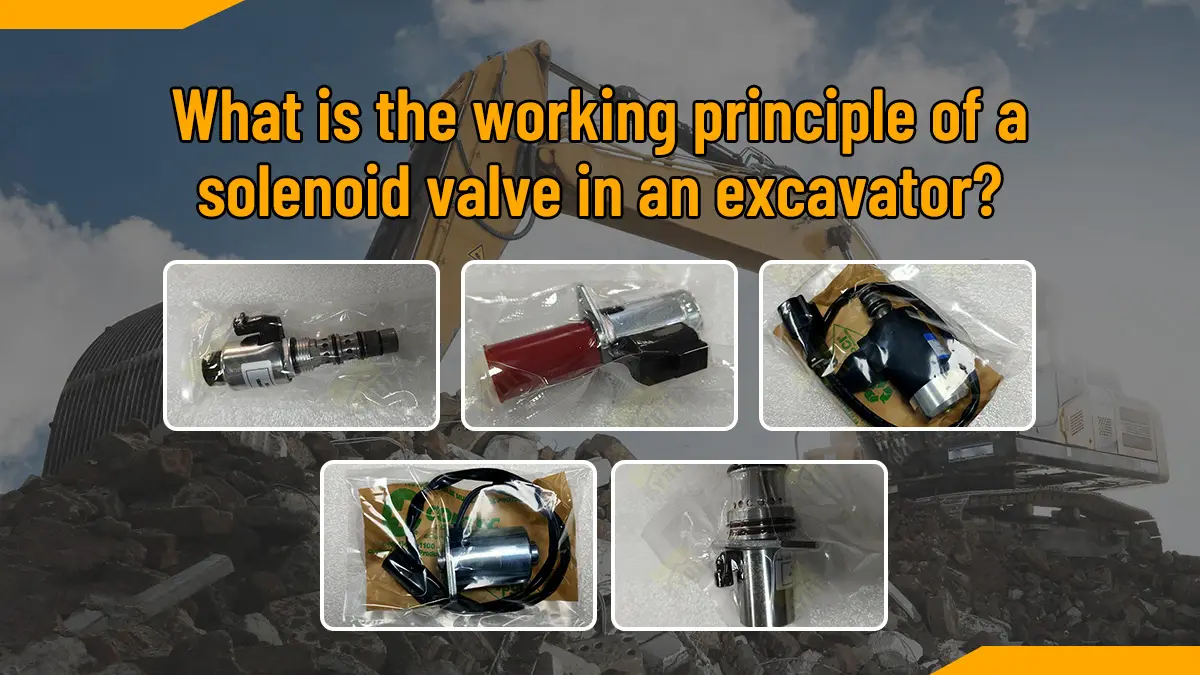
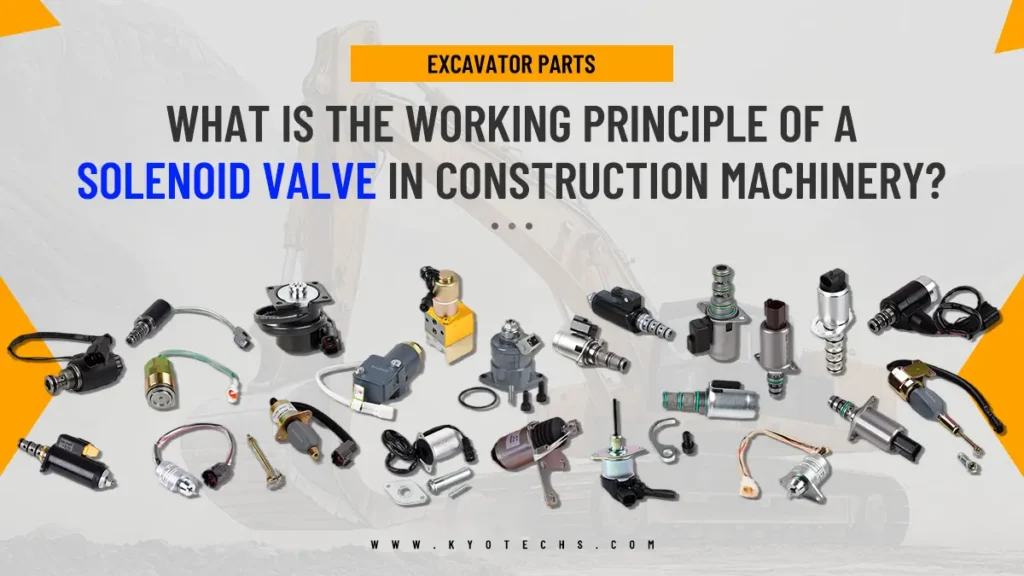
Excavators are indispensable heavy machinery in construction, mining, and infrastructure projects, relying on precise hydraulic control to complete digging, lifting, and swinging operations. At the core of this hydraulic control system is the solenoid valve—a small but critical component that acts as the “switch” and “regulator” of the hydraulic circuit.
The Electromagnet Used to Drive a Solenoid Valve: AC vs. DC Electromagnets
The solenoid valve in an excavator is driven by an electromagnet, which converts electrical energy into mechanical energy to control the valve’s on-off and flow regulation. Electromagnets for excavator solenoid valves are mainly divided into two types: AC electromagnets and DC electromagnets. Each type has unique characteristics and application scenarios, adapted to different working conditions of excavators.
AC Electromagnets
AC electromagnets for excavator solenoid valves typically use a voltage of 220V (industrial standard) and are characterized by large starting force, short commutation time (about 0.1–0.3 seconds), and low manufacturing cost. They are suitable for scenarios where quick valve switching is required, such as auxiliary hydraulic systems in small to medium-sized excavators.
DC Electromagnets
DC electromagnets are more widely used in modern excavators, usually adopting a 24V voltage (consistent with the excavator’s on-board power supply). Compared with AC electromagnets, they have significant advantages: stable operation, no coil burnout even if the valve core is stuck, long service life, and small volume.
Solenoid Valve Structure
An excavator solenoid valve is a integrated component combining electrical and hydraulic functions, consisting of five core parts that work together to achieve precise control of hydraulic fluid. Each part plays a crucial role, and any damage will affect the valve’s normal operation.
1. Electromagnetic Coil
The electromagnetic coil is the “power source” of the solenoid valve, made of copper wire wound around an iron core. When energized, it generates a magnetic field, which provides the driving force to pull the valve core. The coil’s resistance value is an important parameter: a normal 12V coil has a resistance of 3–8 ohms, while a 24V coil has a resistance of 8–20 ohms; a resistance of 0 ohms indicates a short circuit, and infinite resistance indicates a burnt coil.
2. Valve Core (Plunger)
The valve core, also known as the plunger, is a movable metal component inside the valve body, controlled by the magnetic field generated by the electromagnetic coil. When the coil is energized, the magnetic field pulls the valve core to move, changing the position of the fluid channel; when the power is cut off, the valve core resets under the action of the spring.
3. Valve Body
The valve body is the outer shell of the solenoid valve, usually made of brass or high-strength steel to withstand high hydraulic pressure (common in excavators up to 5,000–10,000 psi). It has built-in fluid channels (inlet, outlet, and exhaust ports) that connect to the excavator’s hydraulic pipeline. The valve body’s internal structure is designed according to the valve type, ensuring that the valve core can accurately control the on-off and flow direction of hydraulic fluid when moving.
4. Reset Spring
The reset spring is installed at one end of the valve core, responsible for resetting the valve core to its initial position when the electromagnetic coil is de-energized. Its elasticity directly affects the response speed and reset accuracy of the solenoid valve. In excavator applications, the spring must have strong fatigue resistance to adapt to frequent on-off cycles and vibration environments, avoiding deformation or breakage that would cause valve failure.
5. Sealing Components
Sealing rings (usually O-rings) are installed between the valve core and valve body, and at the pipeline connection, to prevent hydraulic oil leakage. Leakage not only reduces hydraulic system efficiency but also causes equipment failure and environmental pollution. High-temperature and wear-resistant sealing materials are used to adapt to the high-pressure and high-temperature working conditions of excavator hydraulic systems.
Classification of Solenoid Valves
Excavator solenoid valves are classified according to different standards, and understanding the classification helps select the appropriate valve for different hydraulic control scenarios. The most common classifications are based on control mode, operation principle, and normal state.
1. Classification by Operation Principle
This is the most core classification, divided into direct-acting solenoid valves and pilot-operated (indirect-acting) solenoid valves, which are adapted to different hydraulic pressure and flow requirements.
Direct-Acting Solenoid Valves: The electromagnetic coil directly drives the valve core to move, without relying on external hydraulic pressure. They have a simple structure, fast response, and can work normally under vacuum, negative pressure, or zero pressure conditions. However, their flow capacity is small, and they are mostly used in low-pressure, small-flow hydraulic systems of excavators, such as auxiliary oil circuits for small excavator bucket cylinders.
Pilot-Operated Solenoid Valves: Composed of a pilot valve and a main valve. The electromagnetic coil first controls the small pilot valve, which then uses system hydraulic pressure to drive the main valve core to move. They have large flow capacity and can withstand high pressure, making them suitable for high-pressure, large-flow hydraulic systems of excavators, such as main control valves for boom, arm, and swing motors. Their advantage is energy saving and stable operation, but the response speed is slightly slower than direct-acting valves.
2. Classification by Normal State (Without Power)
This classification is based on the valve’s state when the electromagnetic coil is de-energized, which is closely related to the safety and reliability of excavator operation.
Normally Closed (NC) Solenoid Valves: When de-energized, the valve core is closed under the action of the spring, blocking the hydraulic fluid flow; when energized, the coil pulls the valve core to open the channel. This type is the most common in excavators, used in scenarios that require precise control, such as boom lifting, bucket digging, and swing braking. It ensures that the hydraulic system remains in a safe state when the power is cut off, preventing accidental movement of the excavator arm or bucket.
Normally Open (NO) Solenoid Valves: When de-energized, the valve core is open, allowing hydraulic fluid to flow freely; when energized, the coil pulls the valve core to close the channel. They are mostly used in auxiliary systems of excavators, such as cooling fan control and fuel supply auxiliary circuits, where continuous fluid flow is required under normal conditions, and the flow is cut off only when necessary.
3. Other Common Classifications
In addition to the above classifications, excavator solenoid valves can also be divided by number of positions and ports (e.g., 2-position 3-way, 2-position 4-way), which are designed according to the specific hydraulic control needs of the excavator. For example, 2-position 4-way solenoid valves are commonly used to control the forward and reverse movement of hydraulic motors (such as travel motors).
Conclusion
Solenoid valves are the “core control components” of excavator hydraulic systems. Their working principle utilizes the electromagnetic induction of an electromagnet to drive the valve core, thereby controlling the on/off state, flow direction, and flow rate of hydraulic oil, thus achieving precise control of the excavator’s digging, lifting, and slewing actions.
AC and DC electromagnets, as the driving force for solenoid valves, each have their advantages and application scenarios: AC electromagnets are suitable for low-cost, fast-response auxiliary systems, while DC electromagnets, due to their high reliability and long service life, are more suitable for critical systems. The five core components of a solenoid valve—the solenoid coil, valve core, valve body, return spring, and seals—work together to ensure stable operation. Different types of solenoid valves (direct-acting, pilot-operated, normally closed, normally open) can be selected based on the excavator’s hydraulic pressure, flow rate, and control requirements.
Understanding the working principle, structure, and classification of excavator solenoid valves not only helps with correct operation and daily maintenance but also allows for quick troubleshooting (such as coil burnout, valve core jamming, and oil leaks).
If you have any questions or would like to learn more about our products, please feel free to contact us.
FAQs
Which is better for excavator solenoid valves: AC or DC electromagnets?
It depends on the application scenario. DC electromagnets are more recommended for critical hydraulic systems (such as main control valves and swing motors) because of their high reliability, long service life, and no coil burnout when the valve core is stuck. AC electromagnets are suitable for non-critical auxiliary systems where cost control is a priority, as they have large starting force and low price but poor reliability.
What are the common faults of excavator solenoid valves and how to troubleshoot them?
Common faults include coil burnout, valve core jamming, oil leakage, and slow response. Troubleshooting methods: (1) Coil burnout: Use a multimeter to measure the coil resistance; if it is 0 or infinite, replace the coil. (2) Valve core jamming: Disassemble the valve, clean the valve core and valve body with hydraulic-safe solvent, and replace the valve core if it is worn or scratched. (3) Oil leakage: Check the sealing rings and replace them if they are aged or damaged. (4) Slow response: Check the reset spring for deformation and the coil for insufficient voltage (12V valves require 11–12.6V, 24V valves require 23–27V).
How to choose the right solenoid valve for an excavator?
First, determine the electromagnet type (AC/DC) according to the on-board power supply and working reliability requirements. Second, select the operation principle (direct-acting/pilot-operated) based on the hydraulic system’s pressure and flow. Third, choose the normal state (normally closed/normally open) according to the control scenario. Finally, ensure the valve’s model, interface size, and pressure resistance match the excavator’s brand and hydraulic system (e.g., Caterpillar, Komatsu).
How to extend the service life of excavator solenoid valves?
Key measures include: (1) Keep the hydraulic oil clean (use ISO VG 46 hydraulic oil and maintain filtration at NAS 9 or better) to avoid valve core jamming. (2) Regularly inspect the electromagnetic coil for overheating or burnt smell and replace it in time. (3) Check the sealing components periodically and replace them if damaged. (4) Avoid prolonged high-load operation of the excavator to reduce stress on the solenoid valve. (5) Use genuine or high-quality aftermarket parts to ensure compatibility and durability.
Can a faulty solenoid valve affect the overall performance of the excavator?
Yes. A faulty solenoid valve will cause abnormal hydraulic system operation, such as slow or jerky movement of the boom, arm, or bucket, weak hydraulic power, inability to stop the swing motor, or even complete loss of function. In severe cases, it may damage the hydraulic pump, motor, or other components, increase fuel consumption, and cause equipment shutdown, resulting in economic losses.